
Make It Possible
What I learned asking 40+ hospital authorities for their medical equipment purchase records
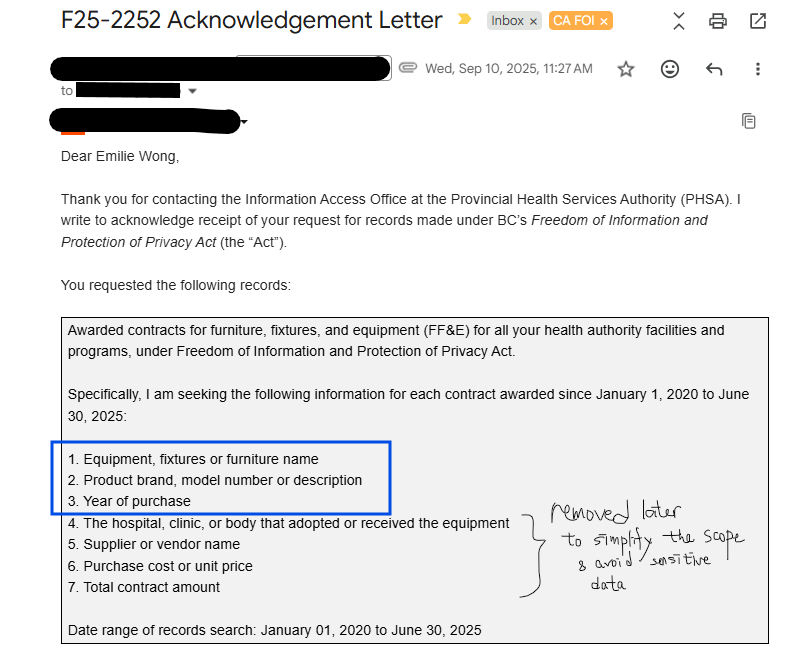
I asked 40+ hospital authorities for a list of the medical equipment they purchased, most had no idea what they actually owned.
I did this last year but haven’t written about it until now, it took time to wrap my head around what’s happening.
I learned about the freedom of information law in most democratic countries, which lets the public request non-sensitive data from any government department managed with tax money. This is how many apps gather interesting data to share with the world.
So I thought it’d be nice to know what medical equipment hospital authorities bought, to inform future purchases. I emailed each hospital authority in Canada, the UK, and Hong Kong, where I am from.
I thought it was a one-click exercise: download an Excel file, or share the FF&E list every hospital building project has.
I expected bureaucratic procedures, but not that most health authorities didn’t know if they kept a record of how they spent public money at all. It took rounds of back-and-forth for officers to understand my request, and they often didn’t know which department kept the record: materials, facility, finance, accounting, or capital planning were all candidates.
So I researched what databases hospitals use (ERP systems), educated the officers on my findings, and kept narrowing my requests to make retrieval easier.
After a long battle, I got 3 lists out of over 40 requests.
Findings:
– NHS UK beats every Canadian institution. They just sent the list, no clarification needed.
– Alberta Health Services and Ottawa Public Health are the only two authorities in Canada with a clean record of their equipment.
– BC’s data is dispersed over 6 systems, so aggregating a small set of purchases over 50k CAD took 36 manual hours. (The capital threshold is 5000 CAD, meaning extra man-hours to approve purchases they then couldn’t track.)
– Ontario has the most individual authorities, each with no idea where the data is. Once they understood, each needed enormous manual hours to aggregate it, despite managing fewer hospitals than other provinces.
– Winnipeg Regional Health Authority said the data doesn’t exist or can’t be located.
– Quebec Public Health never responded, violating the law.
– Hong Kong tried rejecting me by quoting legal clauses the officer didn’t understand, then had to ask the Department of Justice when challenged.
– A few authorities rejected me for cybersecurity reasons, since a device’s brand could help an attacker hack it. Yet these same authorities publish news highlighting the model number whenever they buy an expensive device, to show they “embrace innovation.”
Too much detail for one post, I’ll keep talking.
My conclusion: past learnings never inform decisions in broken systems.
Note: if I’d paid a fee for some authorities to manually aggregate the data, I’d have gotten more lists back. That wasn’t the intention, and wouldn’t have helped either party anyway.
Someone you know has been through this? Forward it to them.